
The very first thing you need to do after a crash is call 911 or the local police department to get officers to the scene. Since you are in an unfamiliar area, having an official police report is absolutely critical because it serves as an unbiased record of what happened, which is vital for insurance claims later. Make sure you tell the dispatcher exactly where you are and request a copy of the report number before the officers leave so you can access it from home later.
While you wait for help to arrive, you must exchange detailed information with all other drivers involved in the collision. You need to write down their full names, phone numbers, insurance policy numbers, and driver’s license numbers, while also paying special attention to their license plates and which state the vehicle is registered in. Gathering these details right away prevents confusion later, especially when dealing with drivers who live in a different jurisdiction than you do.
Your safety is the top priority, so you should immediately check yourself and your passengers for any injuries before doing anything else. If the vehicles are movable and it is safe to do so, try to move them to the shoulder to avoid blocking traffic, and turn on your hazard lights to warn other drivers. Taking these safety measures helps prevent secondary accidents while you wait for emergency responders to secure the scene. 🚓
Photographing the Scene Thoroughly
Taking clear photos is one of the best ways to tell the story of the accident, so start by photographing the vehicle damage from multiple angles. You should get close-up shots of dents and scratches, but also take pictures of skid marks on the road, traffic signs, and current weather conditions. These visual details provide hard evidence that can prove how the crash occurred and who was at fault.
Make sure you take specific photos of the license plates of every car involved, clearly showing the state names on the tags. If you or your passengers have any visible injuries like cuts or bruises, photograph those immediately as well. Capturing these specific details helps link the physical damage and bodily harm directly to the accident event. 📸
It is also important to take wide shots of the entire accident scene to show the layout of the intersection or highway. Try to include nearby landmarks, businesses, or mile markers in these photos to establish exactly where the crash took place. Context photos like these help insurance adjusters and attorneys understand the environment where the collision happened.
Finally, ensure that you preserve these photos on your phone or camera without editing or altering them in any way. Most smartphones automatically add a timestamp and location data to photos, which verifies exactly when and where the evidence was collected. Keeping these original files safe ensures they remain credible evidence for your future legal or insurance needs.
Collecting Witness Information
If there are people who saw the accident happen, you need to approach them calmly and ask for their contact information right away. Write down their names, phone numbers, and email addresses, and if they are willing, ask them to record a brief voice memo or write a short note about what they saw. Securing this contact info immediately is vital because witnesses often leave the scene quickly and can be hard to track down later.
“Texas’ car owners are legally required to carry a minimum amount of liability coverage on their vehicles: at least $30,000 per person for bodily …” -Crosley Law
Witness accounts are incredibly important in out-of-state cases because they provide a neutral perspective that corroborates your version of events. Since you and the other driver may live in different places, having a local witness can help clear up disputes about traffic patterns or light cycles. Their testimony can be the deciding factor if the other driver tries to change their story after returning to their home state. 🗣️
Understanding Police and DMV Reporting Requirements
After the crash, you must ensure that a formal accident report is filed with the local police department in the state where the accident occurred. Do not assume that your home state’s police can help you; you need the official document from the jurisdiction where the crash happened. Obtaining this specific report is the foundation for any successful claim you will make with insurance companies.
In addition to the police report, many states require you to file a separate report with their Department of Motor Vehicles (DMV) or similar agency. These states often have specific rules, such as requiring a report if property damage exceeds a certain dollar amount or if anyone was injured. Failing to file these state-specific forms can lead to complications with your driver’s license, so you must check the local rules immediately.
You also need to be aware of the strict deadlines for filing these reports, which can vary significantly from state to state. Even though you are a resident of another state, you are still bound by the reporting laws of the state where you were driving. Ignoring these timelines can jeopardize your ability to recover damages, so prompt action is necessary to protect your rights.
“Take pictures of the crash scene, your injuries, and the damage to the vehicles involved.” -Crosley Law
Seeking and Documenting Medical Attention
Even if you feel fine, you should seek medical attention immediately at the scene or at a local emergency room. The adrenaline from the crash can mask serious injuries, and seeing a doctor right away creates an official medical record linking your condition to the accident. Delaying treatment can give insurance companies a reason to argue that your injuries were not caused by the crash. 🏥
As you go through treatment, you must meticulously track every single medical record, doctor’s note, and pharmacy receipt. Take photos of your injuries as they heal and keep a file of all discharge papers and instructions given to you by the out-of-state medical providers. This documentation serves as a paper trail that proves the severity and cost of your injuries.
Once you return home, it is important to continue your medical care with your regular doctors and provide them with the records from the accident state. Make sure your home doctors explicitly note in your files that your current treatment is a continuation of care for injuries sustained in the car crash. This continuity of care is essential for ensuring your medical bills are covered by the at-fault party’s insurance.

Which State’s Laws Govern Your Claim
Generally speaking, the laws of the state where the accident actually happened will control who is liable and what damages you can recover. This means that even if you live elsewhere, the accident state’s rules regarding speed limits, right of way, and statutes of limitations will apply to your case. Understanding this is crucial because the laws in that state might be very different from the laws in your home state.
“Texas Transportation Code § 601.051 states that ‘a person may not operate a motor vehicle in this state unless financial responsibility is established for that vehicle.'” -JA Law Firm
However, there are sometimes exceptions to this rule depending on the specific circumstances and insurance policies involved. Complex legal concepts like “most significant relationship” tests can sometimes shift which laws apply, which is why it is smart to consult with experts. Services like those at https://thesuperlawyer.com can help you understand these jurisdictional nuances. Getting professional advice helps ensure you aren’t caught off guard by unexpected legal hurdles.
Notifying Insurance Companies Effectively
You should notify your insurance company about the accident as soon as possible, ideally within 24 hours. When you call, provide them with the facts and all the evidence you have gathered, such as the police report number and photos. Prompt notification shows that you are cooperating and helps get the claims process started before memories fade.
Dealing with out-of-state insurance companies can be tricky because coverage limits and regulations often differ across state lines. You may find that the other driver has minimum coverage that is lower than what you are used to in your home state. Being aware of these potential coverage gaps early on allows you to explore other options, like your own underinsured motorist coverage.
Throughout this process, keep a detailed log of every phone call and email you exchange with any insurance representative. It is also wise to avoid giving a recorded statement to the other driver’s insurance company without first seeking legal advice. Protecting your words ensures that nothing you say can be twisted and used against you later in the negotiation process. 📞
“In Texas, the statute of limitations for personal injury and property damage claims is two years from the date of the accident (Tex. Civ. Prac. & Rem. Code § 16.003).” -Patterson Law Group
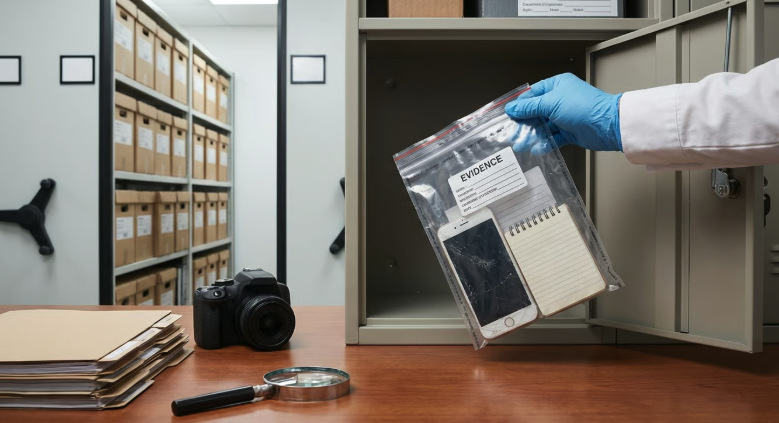
Preserving Evidence for Insurance and Legal Claims
One helpful way to document your experience is to keep a daily journal describing your pain levels and how the injury affects your daily life. Write down things you can no longer do, like lifting groceries or sleeping comfortably, to show the non-economic impact of the crash. This personal record adds a human element to your claim that dry medical bills cannot convey.
You must also retain every single physical receipt, repair estimate, and rental car invoice in a dedicated, organized file. Do not throw anything away, as even small expenses like parking fees for doctor visits can add up and be reimbursed. Having a complete financial picture makes it much easier to calculate the total compensation you deserve.
Finally, make digital backups of all your documents and photos so that nothing gets lost if your phone breaks or papers are misplaced. Also, avoid having your vehicle fully repaired until the insurance adjuster has had a chance to inspect it thoroughly. Preserving the physical evidence of the car damage is often necessary to prove the force of impact and the extent of the loss.
When to Consult an Attorney for Out-of-State Crashes
Because accidents involving multiple states involve complex laws, it is highly recommended to get an attorney involved early in the process. A lawyer can help you navigate the confusing web of jurisdiction issues and ensure you don’t miss any critical filing deadlines in the accident state. If you are unsure where to turn, checking resources like https://thesuperlawyer.com can connect you with the right legal support for your specific situation. ⚖️
“Texas state law requires drivers to provide valid proof of insurance along with their name, address, vehicle make, and registration number after …” -Karns & Karns
An attorney can also handle the heavy lifting of filing paperwork and negotiating with aggressive insurance adjusters who might try to underpay you. They understand the local court systems and can determine the best venue for filing a lawsuit if a settlement cannot be reached. Having professional representation levels the playing field and significantly increases your chances of a fair outcome.
Common Pitfalls in Cross-State Accident Documentation
A major mistake many people make is delaying the police report or medical care because they just want to get home quickly. Leaving the state without documenting the crash creates a huge gap in evidence that insurance companies will exploit to deny your claim. You must prioritize gathering evidence on the spot, even if it delays your trip home by a few hours or a day.
Another common trap is accepting a quick, lowball settlement offer from an insurance company that knows you live far away. They often hope you will take a small amount of money just to avoid the hassle of dealing with a claim in another state. Be patient and do not agree to any settlement until you fully understand the long-term costs of your injuries and repairs.
Finally, never admit fault or apologize at the scene, as these statements can be used against you in court later. Even saying “I’m sorry” out of politeness can be misinterpreted as an admission of guilt. Stick to the facts when talking to the police and other drivers, and do not sign any documents admitting liability without a lawyer reviewing them first.
FAQ
Do I need to file a report in both my home state and the accident state?
You definitely need to file a police report in the state where the crash occurred, as that is the primary jurisdiction. However, you should also check with your home state’s DMV, as some states require you to report any accident you are involved in, regardless of where it happened.
How soon must I notify my insurance after an out-of-state crash?
Most insurance policies require you to notify them promptly, which typically means within 24 to 48 hours of the accident. It is best to call them as soon as it is safe to do so and provide them with all the documentation you have gathered to avoid any coverage disputes.
Can I sue in my home state if the accident was elsewhere?
Usually, you must file a lawsuit in the state where the accident happened or where the defendant lives, not necessarily where you live. However, this depends on whether the defendant has significant ties to your home state, so you should consult an attorney to determine the correct venue.
What if the other driver is from a no-fault state?
If the accident happened in a no-fault state, that state’s rules will generally apply to your claim, meaning you may have to rely on your own insurance for medical bills first. This can significantly impact how you seek compensation, so understanding the local insurance laws is vital.
Should I get treated in the accident state or wait until home?
You should absolutely get treated immediately in the state where the accident happened to ensure your health is stable and to create an immediate medical record. After your initial emergency treatment, you can then transfer your care to doctors in your home state for long-term recovery.
Conclusion
Dealing with a car crash is stressful enough, but when it happens far from home, the stakes are even higher. The key takeaways for protecting yourself include prioritizing safety, thoroughly documenting the scene with photos, and understanding that the laws of the accident state will likely govern your claim. By acting quickly to secure police reports and medical records, you build a foundation of evidence that bridges the gap between state lines.
Don’t leave your compensation to chance; immediately gather all evidence after your out-of-state crash by following these steps—photograph everything, secure reports, seek medical help, notify insurers, and consult a local attorney to protect your rights and maximize compensation. Taking these proactive measures is the only way to ensure you aren’t taken advantage of by insurance companies.
Proper documentation is the bridge that connects what happened on the road to the settlement you deserve. Remember that police reports establish the facts, photos provide visual proof, and medical records link your injuries directly to the crash. With the right evidence and professional legal advice, you can navigate the complexities of an out-of-state accident and secure the justice you are entitled to. 📝